

How To Set Up Argon For Mig Welding
Those learning to MIG weld aluminum will quickly realize that this type of welding poses many challenges. To be able to successfully MIG weld aluminum, y'all must use techniques and set-upwardly strategies that volition be described in total detail in this guide.
MIG welding aluminum requires techniques and welder settings that will compensate for the material's susceptibility to many deformities, such every bit weld cracking. No affair what, aluminum is always MIG welded using DCNP current. There are a diversity of other motorcar settings that must be finely-tuned for the weld to be successful.
Here you volition learn how to set up-up your MIG welder for aluminum. As part of the procedure, yous will learn how to select the correct filler metal for the specific blazon of aluminum that you plan on welding. You lot will besides learn how to adjust essential variables, such as voltage and wire feed speed.
What'southward Dissimilar Well-nigh MIG Welding Aluminum?
MIG welding aluminum poses different challenges than welding mild steel, due to the physical and chemical backdrop of aluminum. Workpieces made of aluminum are more susceptible to welding defects that volition be discussed in further detail below. Fortunately, these defects can exist easily prevented if you use the right techniques and ready your equipment upwards for MIG welding aluminum.
Low Melting Point
Aluminum has a melting point of just 1220 degrees Fahrenheit. Aluminum workpieces accept a protective oxidized layer that melts at 3700 degrees Fahrenheit. The protective oxide must be removed from the workpiece prior to being welded.
Carbon steel has a melting point in the range of 2600 to 2800 degrees Fahrenheit and does not comprise a protective oxidized layer with a melting point that is drastically different from that of the base of operations metal. Some other challenge to working with Aluminum is the fact that it is simply not as workable every bit other base of operations metals.
Porosity
Aluminum is likewise more than sensitive to defects and impurities caused by welding. Aluminum absorbs hydrogen at a rapid stride when it is heated into a molten land. The hydrogen separates out from other components as the metal returns to its solid-state. Bubbling are left behind, and the metal can go porous and weak.
I recently wrote an commodity on this subject, accept a wait at it: eleven common Welding Defects and How to Foreclose Them
Impurities
Aluminum welds are particularly vulnerable to contamination from clay, debris, and moisture in the environs. The welding of aluminum requires special care to ensure that the weld site does not become contaminated and thereafter weakened. Proper filler cloth and shielding gas option are mission-disquisitional to preventing contamination.
Thickness
Burnthrough is a common welding defect in aluminum pieces. This is because aluminum pieces are oftentimes thinner than what a welder is used to, especially if they typically work with carbon steel. Motorcar body repair frequently involves the welding of aluminum pieces that are vulnerable to burnthrough.
Start Out By Cleaning The Aluminum Surface
When yous are welding aluminum, your first step should involve cleaning the surface of the aluminum. This will vastly reduce the opportunity for contaminants such as grit and wet to enter the weld and weaken it. There are several solvents that you can use to help clean the aluminum.
Acetone is e'er a expert pick for cleaning grease, oil and water vapor off of aluminum. Simply wet a cloth or shop towel and scrub the piece down. You may likewise use a stiff soap such as Oil Eater Cleaner/Degreaser. If you happen to utilise a citrus-based degreaser, exist sure to rinse the aluminum before welding.
Brush Off The Oxidized Layer Before Welding
Aluminum melts at 1220 degrees Fahrenheit, but the protective oxidized layer at the surface of the aluminum doesn't melt until 3700 degrees Fahrenheit. The aluminum cannot be MIG welded without the protective layer being removed showtime. Fortunately, removing the oxidizing layer is a pretty straightforward procedure.
You can remove the surface oxides off of an aluminum piece by using a stainless steel wire brush. Information technology is important that you remove contaminants using a degreaser earlier using the wire brush. Otherwise, you lot may embed hydrocarbons or other contaminants into the aluminum. The wire castor method is the recommended method for beginners.
An alternative method involves using less scrubbing to remove the oxides. At that place exist oxide-removal solutions, such as this i . You are strongly encouraged to take extra care when using such chemicals. When used in excess quantities, these chemicals can actually impairment the aluminum. For this reason, beginners are encouraged to employ the wire brush method to remove surface oxides from aluminum.
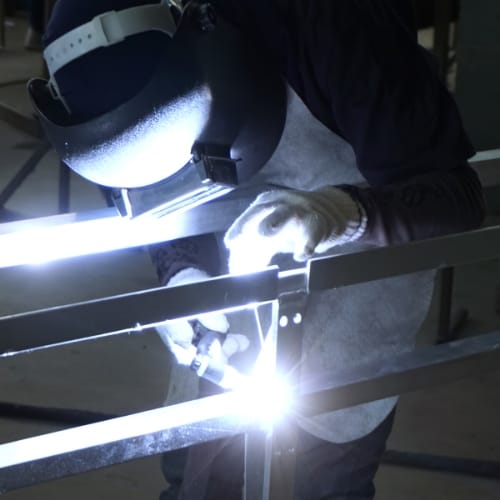
Select The Correct MIG Welding Electrode Wire
Take the fourth dimension to consider which MIG wire works the all-time for your needs. There is a specific grade of MIG wire electrodes that are designed for welding aluminum pieces. These filler metals have been designed to prevent excess porosity and other such defects commonly associated with the welding of aluminum pieces.
Suitable filler metals for MIG welding Aluminum include:
- ER4043
- ER4047
- ER5183
- ER5356
Of these filler metals, the ER4043 and ER5356 are the almost widely-available filler metals on the market. Ultimately, the recommended filler metal for your aluminum workpiece will depend upon the specific blazon of base metallic. Matching filler metal and base metal will aid prevent the welding defects mentioned before in the article. You tin observe aluminum filler blend selection charts, such equally this one online.
The ER4043 is typically used for automobile collision repair considering it is softer than the ER5356 filler metal. If you lot are performing automotive repair, always be sure to double-check the vehicle manufacturer's manual to encounter if in that location is a recommendation for which electrode you lot use for auto body repair.
You will find that the ER5356 filler metal is more often than not easier to feed through the MIG welding gun. The ER5356 has too been reported to be the most normally used of all aluminum filler metals owing to its strength. It is recommended for utilize with 5086 aluminum alloy, which is commonly used to make minor aluminum boats.
It is also the recommended filler metallic for 3003 aluminum blend, the most popular aluminum alloy on the marketplace . This aluminum alloy is used to make gutter, downspouts, and many other similar aluminum objects found around your home.
You can reasonably assume that yous volition be using the ER5356 MIG wire for most aluminum pieces. Withal, be sure to always check an aluminum alloy filler metallic choice chart to ensure that you are matching the filler metal and the base metal.
Related reading: Dissimilar Types of Welding Rods and Their Uses
Shielding Gas Selection Is Essential
The shielding gas is a disquisitional part of a successful aluminum MIG weld. The purpose of the shielding gas is to protect the weld site from contamination from the gases commonly plant in the surrounding air, including oxygen, nitrogen, and hydrogen. One of the most common impurities in aluminum pieces is backlog porosity, caused by hydrogen bubbling in the weld.
Proper shielding gas option can vastly lower the potential for such impurities to occur. There are some MIG electrodes that do not require shielding gases. These are called flux-cored MIG wires. Nether some circumstances, these electrodes will still need a shielding gas.
When you are welding reactive base of operations metals like aluminum, you should use either pure argon (abbreviated Ar) or an argon-helium mixture (Ar-He). Carbon Dioxide (CO2) or Oxygen (O2) would non be a quality choice for a shielding gas under these circumstances because these shielding gases would really oxidize and deteriorate the weld metallic in this instance.
Pure argon is the preferred shielding gas for welding thin sections of aluminum. Thicker sections of aluminum pieces may demand some mixture of argon and helium for thicker sections, where high oestrus input welds are being deposited. Generally, y'all will be using a pure argon shielding gas when yous are MIG welding aluminum.
Setting Upwardly The Shielding Gas
Setting up the shielding gas is a straightforward process.
- Ensure that your organization is set-up with a combination regulator/flow meter for safety purposes. This system acts to reduce pressure from the cylinder while simultaneously regulating the menstruum of gas towards the welding gun.
Hither is an example of what an Argon flow meter should look like. Setting upward the organisation includes all the necessary maintenance check-ups that will be outlined in full detail in your owner's manual. The recommended menses charge per unit for MIG welding aluminum is 20-30 cubic feet per 60 minutes.
Preheat The Work Piece
Another way to assistance prevent weld deformities is to preheat the workpiece prior to welding information technology. This is non a necessary step, although information technology will be of some help in preventing weld cracks from occurring. The preheating temperature should never exceed 230 degrees Fahrenheit.
Raise the preheating process by placing tack welds at the first and cease of the weld zone. Preheating is more necessary with thicker workpieces. In other circumstances, you will find that it does not necessarily better weld functioning. If you lot are just a beginner, you may not detect yourself preheating pieces all that ofttimes, as long every bit you are not trying to weld thick, heavy pieces.
Nevertheless, it is important to know that there are ways that you can make your life easier. There is a take a chance that your welder volition not generate plenty heat to weld the thickest pieces of aluminum that come up through your shop. If you were to look into preheating aluminum for welding, a good start would be to look into consecration heaters.
Related reading: What is Hot Commencement in Welding? Purpose of a Hot Start in Welding
Consecration Heating
Induction heating systems are 1 of the safest and most reliable tools used to preheat aluminum systems. This is because in that location is no open flame, and the temperature is more controllable with an induction heater than it is with a torch. Consecration heaters consist of a series of heating coils. I of the most useful tools is a portable handheld magnetic induction heater, such as this one.
While this is not a piece of equipment that is essential to being able to MIG weld aluminum, it is certainly a wise investment as it will brand your welding shop more than versatile. Yous tin can detect many uses for a magnetic induction heater outside of welding. For case, you lot will find that this tool is useful for removing rusted or difficult-to-remove fasteners during auto bodywork.
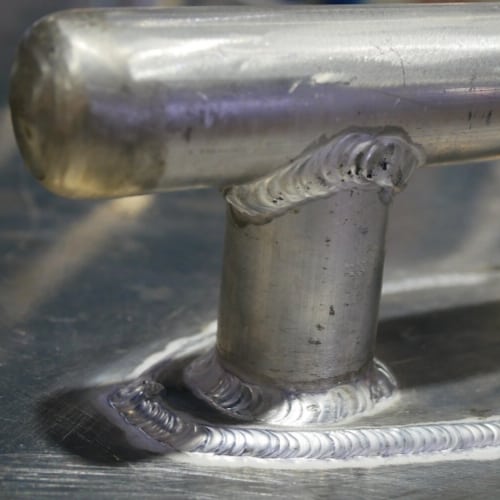
Utilise A Push button-Pull Wire Feeder For Soft Wires
Function of the set-up procedure should involve you familiarizing yourself with the various wire feeding systems used in MIG welding if you haven't done so already. Since the filler metal wires used for welding aluminum are soft, you will need to emphasize looking for a wire-feed arrangement that is adept at handling softer, less rigid wires such as the ER4043.
Here are the basic types of wire feeders:
- Push blazon: the wire is pushed from the spool to the welding gun
- Pull blazon: the wire is pulled from the spool by wire rolls located within the torch handle
- Push-Pull blazon: this organisation consists of a pull motor in the welding gun and a push motor in the feeder, together they add together actress tension to the wire
- Spool Gun type: this organization consists of a small spool of wire that is located on the welding gun
Button-Pull
Push button-pull blazon wire feeders, such equally this one, are commonly used for MIG welding aluminum. This is because they make it much easier to handle the soft wire that is used to weld aluminum. This is particularly the instance when using the ER4043 electrode since it is fifty-fifty less rigid than the ER5356.
I recently wrote an commodity on this subject, have a look at information technology: Practice Yous Pull and Button When Stick Welding
Spool Gun
The spool gun type wire feeders are also frequently used for feeding the soft wires used for welding aluminum. You tin run into for yourself how these systems office by taking a peek at the Lotus Engineering science MSG094 Spool Gun. Keep in heed the fact that this and the other wire feeder referenced in a higher place are not universally-compatible. Always bank check the owner's transmission of your welder to determine which attachments are compatible with your specific organization.
Related reading: Practise You need a Spool Gun to Weld Aluminum?
Setting Up The Essential Variables in the Welding Process
The essential variables in the welding process are the automobile settings that alter the functioning of the welding arrangement. Fifty-fifty the slightest of adjustments can have a drastic impact on weld quality. MIG welding aluminum requires the essential variables to be finely-tuned in the ways that are described in further detail downward below.
Current
At that place is only one type of current that is uniform with aluminum during the MIG welding process.
Straight current, reverse polarity (DCNP) is the type of current that is utilized for MIG welding aluminum. The electrode is connected to the positive pole while the work, also known every bit the "ground," is negative. If you practice not use DCNP, then your weld volition become subject to many types of welding deformities.
Amongst others, these deformities include
- Backlog porosity
- Burn-through
- Weld cracking
If you lot are used to SMAW or stick welding, then you are used to beingness able to change the current and polarity depending upon the application. If you are MIG welding aluminum, then yous really do not have a choice as far as which type of current and polarity will work best for this awarding.
Wire Type And Size
Wire type selection was discussed in a section above. Wire types must be matched to the base metal. As for wire size, that depends upon iii things:
- The suggested mode of metal transfer
- The thickness of the aluminum
- The position at which the weld volition be formed.
Start off the process of selecting wire size by looking at the welding parameter chart that should be located on the welding machine itself. This nautical chart will tell yous the MIG wire types that the car and weld gun are compatible with. In general, it is recommended that you select a wire that is 0.030 inches or 0.035 inches in diameter for welding aluminum.
If you search for aluminum MIG wire online, you volition find that many of the ER4043 and ER5356 filler metals come up in either the 0.030 or 0.035-inch sizes, every bit is the case with this Hobart ER5356 Aluminum Welding Wire.
MIG Contact Tip Sizing
The contact tip is the role of the MIG welding gun that is responsible for transferring the current to the wire existence fed through the gun. The contact tip needs to exist sized properly for the machine to be able to successfully weld aluminum. The inner diameter of the contact tip should be matched to the diameter of the wire.
If you were to apply a 0.035-inch bore MIG wire, then y'all would want to outfit your weld gun with a 0.035-inch diameter contact tip that is compatible with your MIG welder.
E'er check to see that the contact tip is uniform with your welding equipment prior to purchase, as these components are not universally-compatible.
Voltage Settings
Voltage is the source of estrus during the MIG welding process. The proper voltage setting depends upon intricate details that will be discussed in further detail below.
That being said, the manufacturer of the welder should accept included a nautical chart of recommended wire feed speed and voltage settings. Go along your settings consequent with manufacturer recommendations.
Your MIG welder probably has punch knobs for you lot to alter the voltage and wire feed speed, as is seen in the user transmission for this MIG welder. If you suit the voltage setting to a high voltage, you will notice a long arc length. If you adjust the voltage setting to a low voltage, so you volition notice a tight arc length and narrow weld bead.
The proper voltage setting is dependent upon:
- Aluminum thickness
- Type of joint
- Welding position
- Electrode size
- Type of weld
There is definitely a sweet spot when information technology comes to voltage settings. If the voltage is too loftier, there volition be excessive spatter. If the voltage is too low, then there will be excessive porosity and a lack of fusion. The best way to observe the right voltage settings is via a gear up of trials on exam pieces of aluminum. Past performing a set of trials, you lot will be able to get a experience for the specific settings that your machine operates best under.
Wire Feed Speed
The guidelines for adjusting the wire feed speed are similar to the guidelines for adjusting the voltage. Getting a feel for what works correct starts out adjustments based on manufacturer guidelines.
You lot should besides perform trial runs on examination pieces while making incremental changes to the wire feed speed. The wire feed speed is measured in inches per minute and controls the welding amperage in MIG welding.
- A wire feed speed that is too irksome will issue in an arc that is so long that it might even burn the contact tip in a process that is referred to as "burnback."
- If a wire feed speed is likewise fast,so the weld bead will feature a high crown and lots of spatter with fiddling fusion. It is vital that you pay attending to both voltage and wire feed speed.
Mode of Transfer
The recommended mode of transfer for MIG welding aluminum is spray transfer, which has been compared to the spray of h2o out of a garden hose. The spray is typically smaller than the diameter of the MIG wire beingness used. The voltage and wire feed speed should as well be fix relatively high.
Setting Upward The Not-Essential Variables
Your final step for setting up a MIG welder for aluminum involves tweaking the non-essential variables. These are considered non-essential variables because they are altered in the operator'southward direction.
There are no factory-preset welding travel speeds, electrode extensions, or electrode angle settings. There are, even so, recommendations for how to set-upward non-essential variables for MIG Welding aluminum. These non-essential variables will exist covered in this section.
Travel Speed And Estrus Sink
There is not an official travel speed guideline for MIG welding aluminum, as there are many factors specific to the workpiece that will decide what the ideal travel speed is. However, Universal Technical Institute notes that travel speeds and deposition rates are generally high in MIG welding, regardless of specific awarding.
One manner to bring the travel speed under control is to use a "heat sink," as is recommended by Universal Technical Establish. A oestrus sink is a metal piece, often made of copper or brass, that is placed so that information technology is adjacent to a workpiece on a bench. Information technology can assist to reduce the amount of distortion in the aluminum piece. Aluminum sheets are frequently subject to distortion if the travel speed is too slow, and too much heat is applied to the weld.
Electrode Extension
Information technology is of import to control the electrode extension, or "stick-out" when you lot are MIG welding aluminum. This is because the electrode extension determines how the shielding gas behaves and how deeply the arc digs into the base metal. Electrode extension is ordinarily defined as the distance between the stop of the electrode and the contact tip.
Y'all are encouraged to go on the electrode extension or "stick-out" within a range of i/2″ – ¾" inch when you are MIG welding aluminum. This will assistance to prevent problems in which the arc is not digging deep enough or is digging
Electrode Angle
The forehand likewise referred to as "lead angle," is the electrode angle that is e'er used for welding aluminum. The position of the welding electrode relative to the workpiece plays a role in determining weld shape and size. The atomic number 82 angle is considered a "push technique."
This is the opposite of the backhand, or "pull," technique in which the electrode is pointing opposite from the management of travel. In the forehand technique used for MIG welding aluminum, the electrode will be pointed in the direction of travel.
The recommended electrode angle of travel is 5 to xv degrees. If the angle falls within this range, information technology will be much easier to control the molten pool.
Accomplish the Best Quality When MIG Welding Aluminum
In order to attain the all-time weld quality when MIG welding aluminum, you are encouraged to complete the weld with multiple passes of straight beads.
A straight bead, or stringer bead, is a weld bead that is generally narrow. Stronger beads contrast with weaving beads that are much wider and "weave dorsum and forth" forth the length of the weld joint, as the name suggests.
Stringer beads typically let the operator to weld in all positions in almost applications. With a multiple laissez passer dewdrop, you are not trying to consummate the weld in one quick laissez passer. Rather, you are taking your time in being able to lay down direct beads.
Related reading: Tin can MIG Welders weld Aluminum? How to Successful Weld Aluminum
Conclusion
Those who take tried it know that MIG weld aluminum is challenging. Past using the techniques and gear up-up strategies described in total detail in this guide, you should be able to successfully create quality welds and avert the pitfalls mutual to this material'south predisposition to weld cracking and other malformations.
From selecting the correct filler metal for the specific type of aluminum y'all are welding to adjusting the voltage and wire feed speed, your MIG welding technique – and results – will better.
Often Asked Questions
Here are a few common questions people often have about Welding Aluminum:
What blazon of welder is used for aluminum?
metal inert gas is normally used for welding aluminum. The welder you cull should utilize impulse welding or spray arc welding methods.
Spray arc welding requires a constant current and constant voltage machine, while pulse welding requires an inverter power supply.
Is Welded Aluminum Strong?
Welded aluminum is generally weaker than the alloy. In general, with oestrus-treatable aluminum alloys, the cloth is heated to a value betwixt 325 F and 400 F in the concluding heat treatment step.
Can Aluminum Exist Brazed?
Aye, aluminum alloys can exist brazed. Yous can repair holes, leaks, cleaved ears, and cracks with aluminum brazing.
How to "Weld" Aluminum for Beginners >> Bank check out the video below
Hither are some of my favorite tools & equipment´due south
Give thanks y'all for reading this article. I hope information technology helps you find the most recent and accurate information for your welding project. Here are some tools that I utilise daily and hope you´ll besides find helpful.
At that place are affiliate links, so if yous do decide to use whatsoever of them, I´ll earn a minor committee. But in all honesty, these are the exact tools that I use and recommend to anybody, even my own family. (NO CRAP)
To see all my of about up-to-date recommendations, check out this resource that I made for you!
Best Overall
Recommendations
+ Great Products & Services
+ Approved
+ Salvage Thousands of Dollars

Source: https://weldingtroop.com/mig-welding-aluminum/
0 Response to "How To Set Up Argon For Mig Welding"
Post a Comment